
Accelerating early antibody discovery with ensemble-based developability assessment: 3dpredict/Ab
As new research tools and methods are accelerating antibody generation, some early-stage discovery challenges persist, preventing the overall process from becoming as efficient as these advances promise.
Established and emerging technologies, such as phage display and AI-based design, allow scientists to generate thousands of antibody candidates quickly. Yet, evaluating their developability, i.e., identifying which of these sequences will make a stable, manufacturable, and effective drug, remains challenging in biotherapeutic R&D.
Fig 1. Antibody developability parameter
Limitations of traditional methods for developability assessment
Experimental assays, while essential, are costly and might not provide enough throughput.
On the other hand, many computational methods, although efficient, often rely only on sequence. Incorporating 3D structural information (like surface exposure) increases the accuracy of the results.
However, 3D models of antibodies are usually simplified, single-structure representations that do not fully capture antibody conformational dynamics or environmental effects. As a result, critical behaviors may be concealed despite their impact on developability. This includes behaviors in highly flexible regions such as CDR loops or hinge regions, as well as in pH-sensitive regions such as surface-exposed histidines.
Therefore, the practice of using a single structure for property calculations, often referred to as the single-structure bias, may lead to less accurate insights that could affect the pace or compromise the discovery pipeline.
This raises a key question: how can antibody liability be predicted with precision, early, and at scale, while accounting for proteins’ conformational variability and context-dependent behavior?
The ensemble-based approach for property calculations
Discngine’s 3dpredict/Ab
Ensemble-based in-silico methods have been developed to account for conformational flexibility and pH-dependent effects by sampling multiple antibody conformations and protonation states.
By considering this variability, these methods can better capture behaviors that might be missed in single-structure models. As a result, predictions of properties relevant to developability are more accurate and informative.
However, these approaches typically involve complex, multi-step workflows and significant computational resources, which can slow execution and limit their use at larger scales.
To streamline developability assessment efforts, we developed 3dpredict/Ab at Discngine, in collaboration with experts from Chemical Computing Group (CCG) and leading pharmaceutical scientists from our community.
3dpredict/Ab is a cloud-based platform for ensemble-based antibody modeling and property predictions at scale. It is designed to address downstream developability issues by predicting liability risks and evaluating antibody variants through physics-based property calculations.
It ultimately streamlines decision-making in early antibody discovery by rapidly ranking antibody candidates for developability and liability.
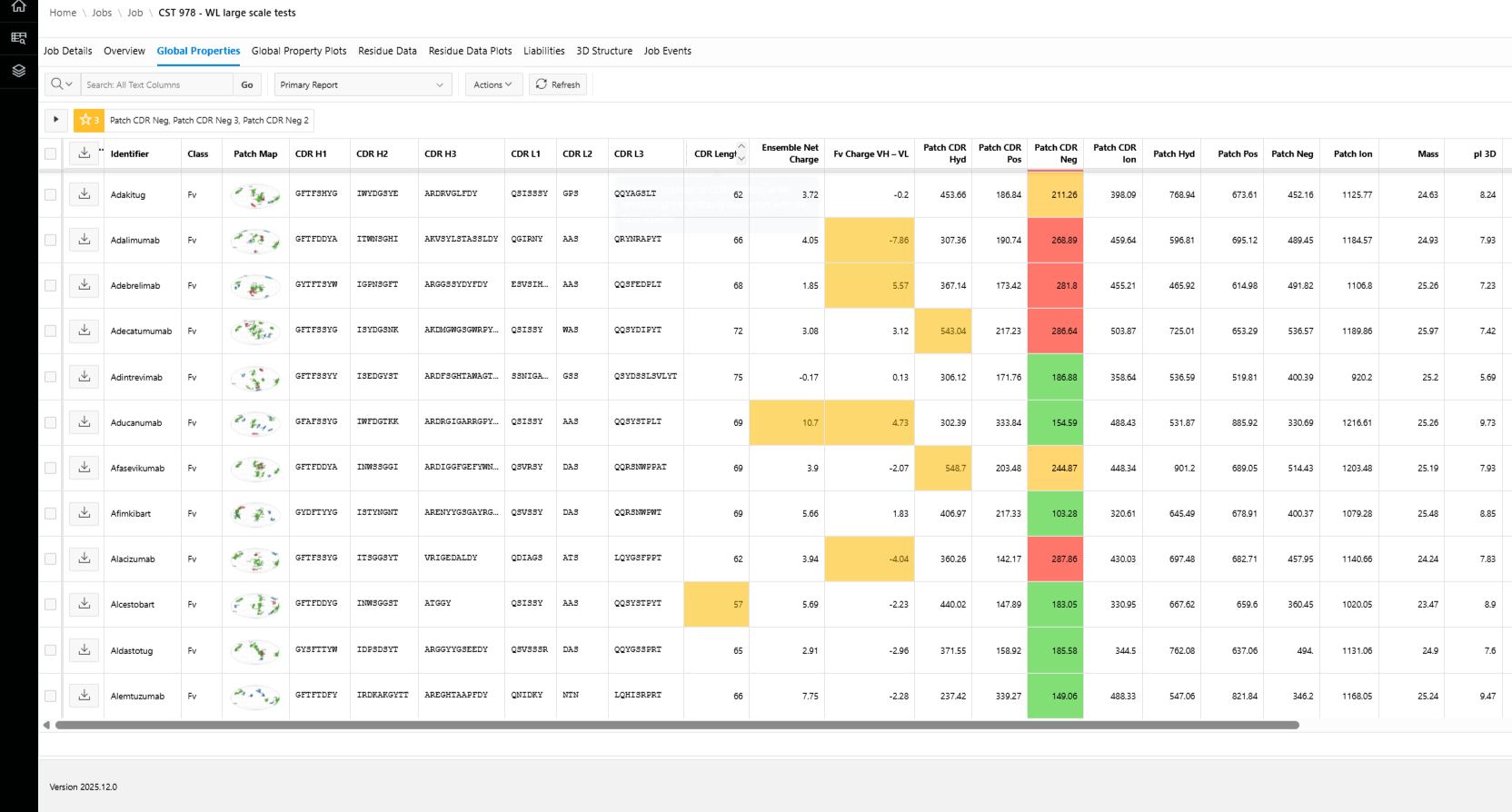
Fig 2. 3dpredict/Ab detects and scores antibody liability risks
An advanced physics-based methodology
Instead of relying on single static structures, 3dpredict/Ab generates ensembles of conformations and protonation states by employing advanced computational methods.
It uses LowModeMD¹ and Monte Carlo Protonate3D² in tandem to build more accurate antibody models.
Fig 3. Computational method for ensemble sampling of antibody conformations across pH
LowModeMD generates conformational ensembles. For each conformation, Protonate3D assigns protonation states/hydrogen positions, modelling how the molecule behaves under different pH (or micro-environment) conditions. The result is a multidimensional ensemble of structures × protonation states.
From this ensemble, over 100 descriptors are computed (hydrophobic patch exposure, charge distribution, liabilities etc.).
These descriptors feed into developability assessments (aggregation risk, viscosity potential, clearance risk, manufacturability) and are systematically compared against clinical-stage antibodies³, allowing researchers to interpret predicted properties in the context of known therapeutic benchmarks.
Fig 4. 3dpredict/Ab’s Overview window for descriptor-based comparison of candidates with clinical-stage antibodies
This workflow supports both large-scale and small-scale screening, with processing capabilities ranging from 28k/day for small antibody formats (e.g. Fv, scFv or VHH variants) to 5k/day for IgG or Bispecifics.
Table 1. High-throughput processing across multiple antibody formats
| Format | Capacity* | Time |
|---|---|---|
| Fv, scFv, VHH | 28 k/day | 30 min |
| Fab | 14 k/day | 50 min |
| Fab2 | 7 k/day | 2 hours |
| Ig, Bispecific | 5 k/day | 3 hours |
*600 16-CPU node cluster
Applications and integration into the discovery process
3dpredict/Ab supports multiple applications in early antibody discovery by generating structural models and computing key developability properties.
In hit optimization, for example, it screens antibody sequences to identify candidates with favorable developability profiles and flags those that are likely to aggregate or express poorly.
In lead optimization, it helps refine sequences by pointing to structural features that influence stability, manufacturability, or overall robustness.
Additionally, 3dpredict/Ab can process input sequences through the same physics-based workflow; the resulting descriptors are consistent and directly comparable. This uniform dataset can then be used to train and validate machine-learning models, enabling more reliable predictive tools.
To support these applications, 3dpredict/Ab is built on a cloud infrastructure and is accessible through both a graphical interface and an API. This allows seamless integration into in-house computational pipelines and enables predictions to complement existing antibody design tools and experimental data.
Conclusion
By sampling multiple conformations and protonation states, ensemble-based calculations provide more accurate estimates of antibody properties and can reveal potential liabilities that single-structure models may overlook.
Building on this approach, Discngine collaborated with Chemical Computing Group to develop 3dpredict/Ab. The software generates antibody ensembles and performs high-throughput liability screening, helping to mitigate single-structure bias. Its outputs support researchers in the rapid assessment and prioritization of candidate antibodies in early discovery, all within an easy-to-use interface and secure cloud environment.
Learn more about 3dpredict/Ab and how it can support your antibody-discovery projects
References
1. Labute, Paul. “LowModeMD--implicit low-mode velocity filtering applied to conformational search of macrocycles and protein loops.” Journal of chemical information and modeling vol. 50,5 (2010): 792-800. doi:10.1021/ci900508k
2. Labute, Paul. “Protonate3D: assignment of ionization states and hydrogen coordinates to macromolecular structures.” Proteins vol. 75,1 (2009): 187-205. doi:10.1002/prot.22234
3. Thorsteinson, Nels et al. “Structure-Based Optimization of Antibody-Based Biotherapeutics for Improved Developability: A Practical Guide for Molecular Modelers.” Methods in molecular biology (Clifton, N.J.) vol. 2552 (2023): 219-235. doi:10.1007/978-1-0716-2609-2_11
Stay updated on our upcoming events, scientific blog articles and other activites by subscribing to our newsletter!