
The understanding of Structure-Activity Relationship (SAR) evolves throughout a discovery program. Each newly tested compound can confirm an existing trend, reveal an exception, or reshape how the whole series is interpreted.
A static report struggles to keep pace with that evolution: medicinal chemistry teams need a way to review data as it comes in without restarting the analysis, and to communicate the resulting SAR clearly across teams — which gets harder as the series grows.
Ideation Analytics 3.0 now supports this through shared projects, dataset updates, and report-wide visual settings – all in a redesigned interface. The release also extends SAR analysis and reporting to peptide programs.
To learn more about Ideation Analytics and its SAR analysis and reporting capabilities, read our previous article introducing the platform.
Projects and shared access
SAR analysis is inherently collaborative. Medicinal chemists, computational chemists, and project leaders often need to review the same data from different perspectives.
In Ideation Analytics 3.0, SAR work is now organized into public projects (accessible to every scientist at your company with an Ideation Analytics subscription) or private projects. Datasets, SAR slides, and reports are maintained within the project, and colleagues can be assigned Owner, Editor, or Viewer permissions.
Rather than circulating separate report files, teams can now review the analysis in a shared workspace with access managed at the project level.
Enterprise-level collaboration through shared SAR projects
Dataset update and report-wide visual settings
SAR reports are often assembled while experimental data is still changing. New molecules are synthesized, additional endpoints are measured, and existing values may be revised. When the underlying dataset changes, the analysis must be reviewed in light of new evidence.
With this release, a dataset can now be updated directly from its original source. It accounts for changes to structures, endpoints, and values, all of which are listed for review before they are applied. Reports previously built on that dataset can now be refreshed rather than rebuilt.
As reports are refreshed and built up over time, slides configured separately within them can end up presenting the data inconsistently. Global Report Settings enable visual parameters to be defined once for the whole report, or set on one slide and propagated across the rest. With these settings, SAR slides can stay consistent as reports grow.
Peptide SAR analysis and reporting within Ideation Analytics
A peptide program raises the usual SAR questions: which positions tolerate substitution, which modifications drive activity, and what is happening chemically at a given residue. The chemistry, however, does not fit the small molecule scaffold-and-substituent view. A peptide series is defined by sequence position, by non-natural and modified monomers, and by cyclization or bridging.
As SAR tooling has developed mainly around small molecules, peptide SAR is often still assembled by hand: sequences, modifications, and activity data reconciled in spreadsheets and slides - and rebuilt each time the dataset grows. Some peptide-specific tools have emerged, but teams still lack a single environment that brings together sequence-level patterns, the underlying chemistry, and the reporting that follows from them.
Ideation Analytics 3.0 closes that gap for peptide teams by extending SAR analysis and reporting to peptide programs.
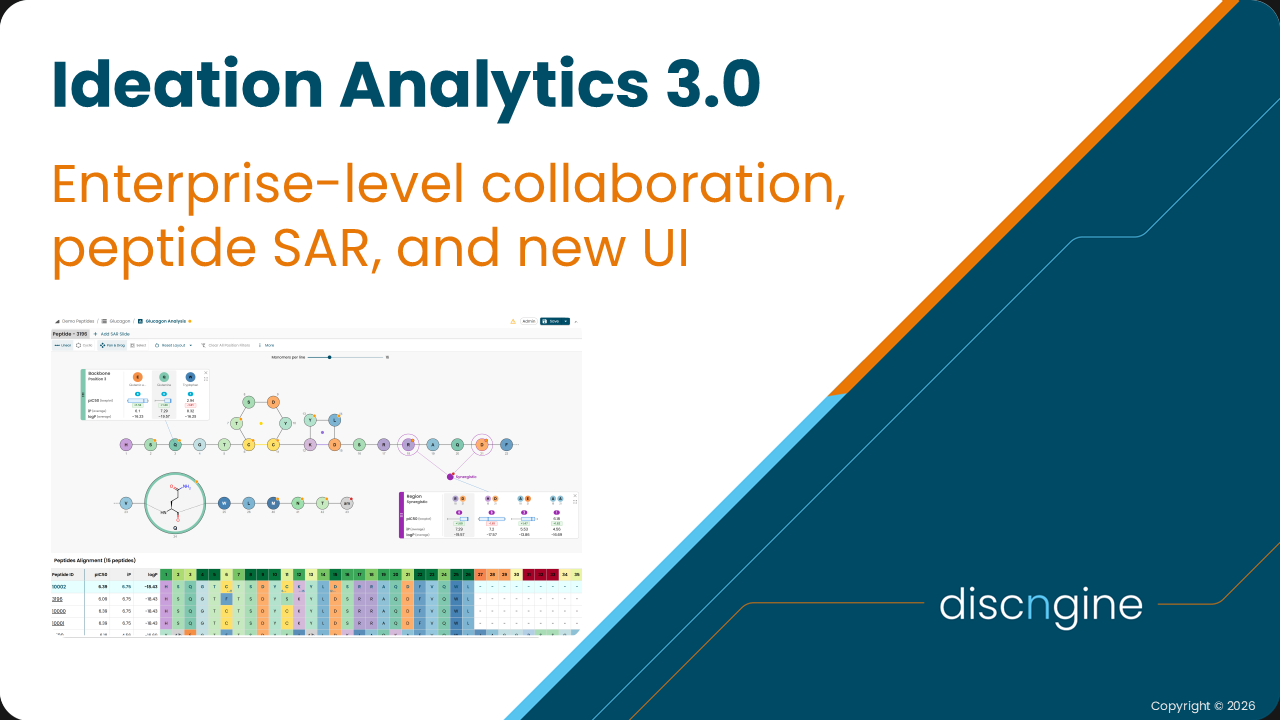
Within the platform, sequences are automatically aligned with position numbering, giving a common frame for comparing analogues.
Regions of interest can be explored to see which variants they contain and how their activity and properties compare. A position can then be followed down to the monomer and the atom, where structures, bridges, and modifications can be examined, across linear, cyclic, or branched peptides.
The same dataset can also be approached by similarity - with clustering grouping related variants rather than working position by position. Hotspot detection then points to those where changes have the largest effect on activity.
Synergies for specific properties across different positions are also automatically provided by the application.
Peptide SAR workspace in Ideation Analytics 3.0 - bringing together sequence alignment, chemical context, and activity data in a single view
See Ideation Analytics 3.0 in action
To discuss how these workflows could be applied to your small-molecule or peptide discovery program, reach out to our team

Ideation Analytics is a Discngine software for efficient Structure-Activity Relationship analysis and reporting with built-in integrations with common medicinal chemistry in-silico tools, including a patent database extension (currently Excelra GOSTAR™).
To get detailed information on the patent exploration use case and discover Ideation Analytics’ capabilities beyond those covered in this article, visit our product page and get in touch with our scientists.