
Efficient Structure-Activity Relationship (SAR) Reporting and Exploration in Drug Discovery: Discover Discngine Ideation Analytics
On average, a medicinal chemist spends one to two workdays per month generating structure–activity relationship (SAR) reports. Over a year, that adds up to approximately 4 working weeks (or up to 1 whole month) spent on repetitive, data-oriented tasks – the time that could otherwise be dedicated to compound design and optimization.
This estimate is based on our surveys and conversations with dozens of chemists across pharma and biotech. While the exact time and effort for generating SAR reports vary by research organization and the type of report, it is common for chemists to spend hours on this process. The main reason for such time-consuming work is that SAR exploration and reporting remain largely manual, even as the number of columns, compounds, and data points continues to grow.
One chemist captured this challenge well, saying:
“With dozens of compound columns and an ever-expanding list of parameters to consider, the SAR analysis quickly becomes overwhelming.”
In this article, we discuss the main challenges of manual multi-parameter SAR reporting and analysis and present the automated approach that ultimately frees chemists' time to focus on compound optimization rather than tedious data handling.
The main challenges of manual SAR reporting
What we’ve learned from the medicinal chemistry teams in large and mid-size research groups is that generating multi-parameter SAR overviews is a very fragmented, inefficient process. This usually comes from a mix of siloed or outdated technology and a heavy reliance on spreadsheets.
Chemists spend significant time moving compound bioactivity data between various platforms - importing data into one platform for analysis, creating visualizations in another, and then compiling results into presentation-ready reports. Building these reports isn’t just about copying and pasting data; it also involves formatting (adjusting text, fonts, alignments, etc.) to keep everything consistent.
Altogether, this manual assembly of SAR summaries consumes up to 2 workdays per chemist each month. Besides being time-intensive, it comes with additional challenges:
High risk of errors: Each manual step increases the chance of human error, which can lead to mistakes and delay projects through additional correction steps.
Frequent rework: Every time new data becomes available—whether it’s a newly synthesized molecule, an assay result, or a property prediction – reports need to be updated and revised, adding to the workload.
Lack of standardization: Chemists have their own reporting style. Inconsistent tables, graphs, and formatting make it harder for adjacent disciplines, such as cheminformaticians, data scientists, and biologists, for example, to interpret and collaborate on SAR findings.
Poor scalability: The manual methods strain under large or complex datasets, which are common in lead optimization campaigns.
Complex patent data: Analyzing diverse patent data with inconsistent assay names and formats becomes very cumbersome without an automated solution.
The extensive description of some of these challenges and their impact is presented in our blog post, “The 3 Hidden Costs of Manual SAR Reporting in Drug Discovery”.
Automation in SAR reports generation, visualization, and updates
Discngine Ideation Analytics
In collaboration with drug discovery experts, particularly medicinal chemistry lab leaders and cheminformaticians from Bayer, Discngine developed Ideation Analytics - a streamlined platform designed to address the challenges in manual SAR reporting and exploration. This solution transforms a traditionally time-consuming and error-prone process into a more efficient, real-time, interactive workflow. With Ideation SAR Slides, medicinal chemists can generate publication-ready SAR reports while continuing to work with existing data sources and common analysis tools. For example, starting from a ready dataset, the comprehensive SAR report with Ideation SAR Slides can be done in under two minutes, compared to hours before.
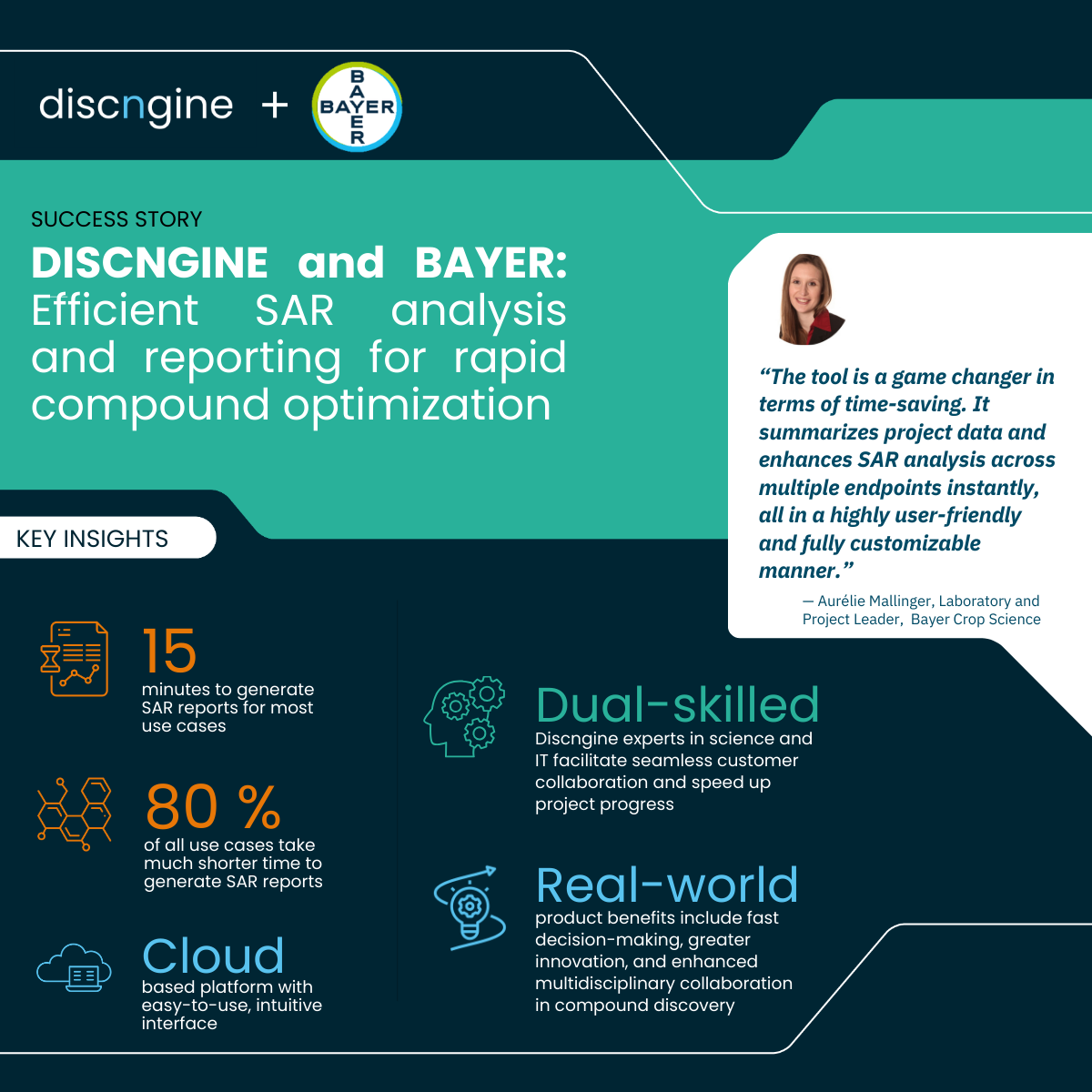
For the full story of how Ideation Analytics was co-created with Bayer’s chemists, read our detailed customer success story: Efficient SAR analysis and reporting for rapid compound optimization: A Discngine-Bayer success story.
How to streamline SAR reporting and analysis with Ideation Analytics?
The workflow in Ideation Analytics starts with importing compound datasets (manually or through integration). Once the data are in the application, a built-in proprietary algorithm, based on Matched Molecular Pairs, automatically fragments molecules and identifies structural relationships. The application can also perform R-Group Deconvolution analysis by starting from a scaffold rather than a compound. The system then generates organized, highly visual SAR reports and associated data with consistent formatting, eliminating manual layout tasks.
Ideation Analytics report preview: Collection of all datasets relevant compounds organized in highlighted, color-coded floating bubbles
The platform’s visual tools enable chemists to dynamically filter and explore SAR data. Within the same application interface, users can rapidly identify activity trends, compare substituents across different scaffolds, and pinpoint key pattern differences between series. In the context of intellectual property and patent exploration, the tool helps researchers spot potential gaps in known chemical space and explore opportunities to introduce novel chemotypes that might otherwise be overlooked in manual analyses.
The output is fully customizable, allowing the user to choose which parameters to include, and the tool ensures consistency and accuracy. Once the report is ready, it can be exported as a high-quality image for a quick drag-and-drop into a PowerPoint slide. Because this report generation method is automatic, chemists can reclaim time from manual work, focusing on the next round of compound design and hypothesis testing. They can achieve far more than they could with manual inspection in the same timeframe.
Ideation Analytics scaffold comparison in the Matrix view: Allows side-by-side scaffold comparison, helping users quickly analyze differences and similarities across chemical series for in-depth SAR exploration.
A key advantage of Ideation Analytics is that it broadens access to consistent, high-quality, and fully customizable SAR reporting across different user groups. It makes advanced SAR analysis more accessible to adjacent disciplines, such as cheminformatics and data science teams. Everyone can view the data from a chemist’s perspective to easily understand science and the compound’s SARs. This shared perspective supports independent exploration and interpretation, fostering more effective collaboration within interdisciplinary project teams.
“I can confidently say that creating SAR reporting has become incredibly efficient. Preparing datasets, uploading them, and generating SAR reports now takes just 15 minutes, compared to hours before. And if the dataset is already available, only seconds.”
How does Ideation Analytics fit into current workflows?
The Ideation Analytics platform is designed to fit into the existing IT infrastructure. The goal for organizations is to connect with their research applications already in use (such as bespoke applications as well as existing software like SchrödingerLiveDesign®, Certara D360™, Spotfire®, etc.). Scientists can access it directly from within their familiar applications, without the need to manually export and re-import data.
From a technological standpoint, the cloud-native and web-based architecture of Ideation Analytics provides on-demand access to the platform, eliminating the need for local installations. It’s provided as a secure Software-as-a-Service (SaaS) solution, and all maintenance tasks, such as updates and patches, are handled by Discngine’s experts. This cloud-based approach not only removes a burden for the IT team but also ensures that the team is always using the latest, most secure version of the software.
The platform was also created with ease of use in mind, with a short learning curve that helps even those less familiar with new tools feel comfortable quickly. Therefore, it encourages broader participation in project work, allowing new team members to get up to speed efficiently, even when joining at later stages.
Overall, Ideation Analytics helps bring more perspectives into the discussion, supporting idea generation and collaborative problem-solving.
Conclusion
Manually extracting and analyzing compound bioactivity data across multiple tools—and formatting reports for communication and decision-making—takes up a significant amount of time for medicinal chemists. As a result, up to a full month each year is spent on tasks that pull the focus away from the core work of optimizing compounds.
Discngine’s Ideation Analytics is a cloud-native application that helps chemists explore structure–activity relationships more efficiently, freeing up time to concentrate on scientific thinking rather than data handling. These time-savings contribute directly to improved research productivity by enabling:
Fewer errors, as automation reduces the risk of manual transcription mistakes that can delay project progress
Faster decision-making, with real-time SAR insights supporting quicker design iterations and shorter discovery cycles
Early assessment of existing drug patents, helping identify opportunities for novelty and innovation
Better collaboration, with standardized, high-quality reports that support clear communication across project teams
Wish to see Ideation Analytics in action? Reach out to our experts!